Surface contact sprays purchase temporary relief while scattering worker ants into subterranean relief tunnels, worsening turf displacement near residential foundations. Professional eradication pairs high-pressure…
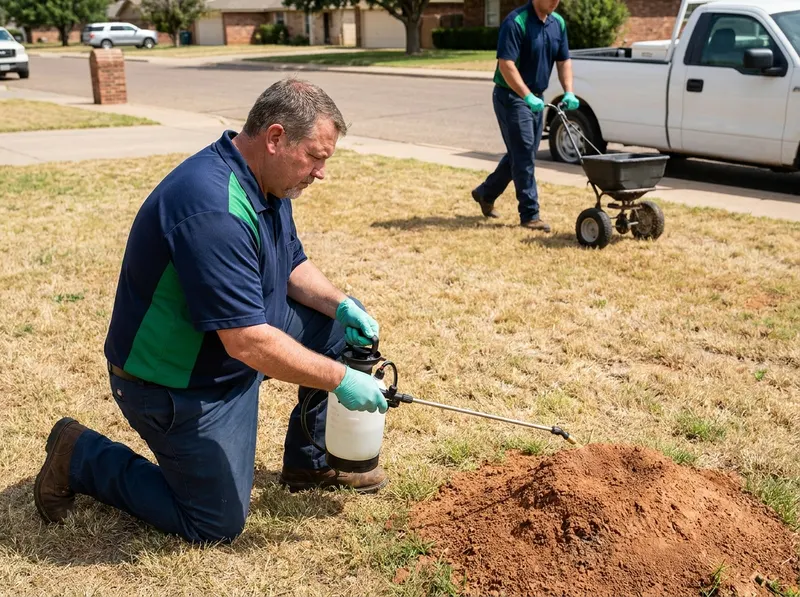
Surface contact sprays purchase temporary relief while scattering worker ants into subterranean relief tunnels, worsening turf displacement near residential foundations. Professional eradication pairs high-pressure pressurized liquid drenching directly into active nest chimneys with broad-spectrum broadcast baiting across manicured lawns. In sandy-loam and clay alluvial soils near the Ouachita River basin, Solenopsis invicta mounds routinely burrow down 4 to 6 feet to trace the seasonal water table, protecting the fertile queen from topical retail powders. Mound drenching introduces 2 to 5 gallons of active liquid solution per primary mound, flooding subsurface galleries, collapsing tunnel architecture, and contacting the reproductive engine immediately. Properties spanning the Garden District, Lakeshore, and Chauvin rely on this targeted flood mechanism to neutralize severe sting hazards surrounding outdoor patios, swimming pool decks, and turf recreation areas.
Secondary broadcast management neutralizes covert colonies before mound construction damages mowing machinery or root systems. Granular broadcast defense disperses micro-encapsulated bait containing insect growth regulators across open grass expanses, including residential lots in Claiborne, Brownsville, and Bawcomville. Foraging workers transport these active components down into hidden cavities, sterilizing the queen and interrupting reproductive nymph cycles within 14 to 28 days. Choosing individual mound treatment over whole-yard broadcast is cost-effective for single isolated mounds on compacted suburban lots; however, the trade-off is vulnerability to re-infestation from unmapped neighbor colonies. Full turf broadcast combined with drenching guarantees unbroken perimeter control against outside vector migration.
Heavy spring humidity and frequent rain events across Swartz and surrounding Ouachita Parish mandate exact weather-window timing. Applications require dry turf blades and zero projected precipitation for 4 to 12 hours post-treatment to preserve the chemical potency of surface baits. Once the liquid mound treatment fully dries, turf spaces regain standard family and pet access without toxic residue tracking into indoor living environments. The dispatch coordination desk facilitates property mapping, boundary acreage calibration, and direct service dispatch via telephone at (225) 497-0153.
Every job gets a firm, written price after a free on-site visit.
Tell us about your fire ant mound drenching & turf broadcast defense job in Lubbock and we'll send a clear, written quote, usually the same day.
 Draxora Pest Care