German cockroach cleanout demands an uncompromising, multi-phase technical deployment rather than passive surface spraying. Off-the-shelf pyrethroid aerosols cause indoor chemical scattering, driving gravid females…
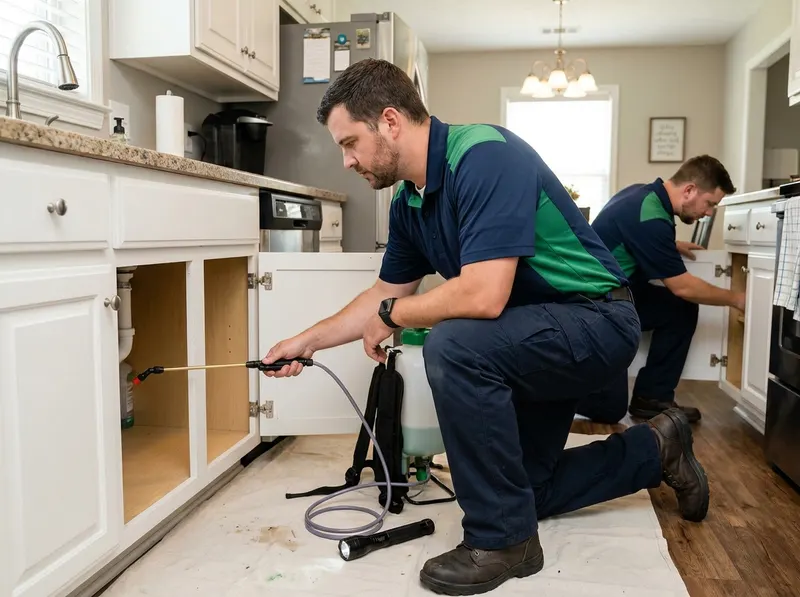
German cockroach cleanout demands an uncompromising, multi-phase technical deployment rather than passive surface spraying. Off-the-shelf pyrethroid aerosols cause indoor chemical scattering, driving gravid females deeper behind sheetrock voids and appliance motor housings. In high-density settings like Downtown Monroe rental units, historical Garden District duplexes, and slab homes near Lakeshore, high humidity accelerates the reproductive velocity of Blattella germanica, producing 30 to 40 nymphs per ootheca every 28 days. A baseline structural intervention deploys non-repellent active baits containing dinotefuran or fipronil alongside an insect growth regulator (IGR) such as hydroprene or novaluron. The growth regulator prevents juvenile instars from reaching reproductive maturity by chemically locking chitin development, cutting off the colony replacement cycle entirely.
Decision guidance relies on infestation intensity and structural boundaries. If cockroach sightings occur exclusively during daylight hours near plumbing penetrations in Claiborne or Brownsville, population pressure has already forced foraging outside primary harborage zones. Single-family homes with isolated galley kitchen activity require focused void cleanouts, whereas multi-tenant housing blocks in Bawcomville, Chauvin, or Swartz require continuous perimeter lockdowns to prevent migration across common party walls. The operational trade-off is chemical persistence versus initial odor profile: microencapsulated suspensions adhere to concrete and untreated wood for up to 90 days under humid conditions near the Ouachita River, but require homeowners to maintain cleared cabinetry, dry surfaces, and unsealed food isolation for 14 days post-treatment.
Phase 1 involves high-efficiency mechanical extraction and void dust injection to eliminate 70% to 85% of the live adult population on day one. Phase 2 introduces insect growth regulators across kickplates, electrical chase ways near University of Louisiana at Monroe off-campus housing, and appliance compressors. Phase 3 relies on strategic bait rotations at 21-day intervals to eliminate newly hatched nymphs before ootheca production resumes. For properties bordered by dense vegetation near Forsythe Park or Black Bayou Lake National Wildlife Refuge, perimeter exclusion seals external utility conduit points, denying external reinfestation entry while internal chemistry finishes the colony.
Every job gets a firm, written price after a free on-site visit.
Tell us about your german cockroach cleanout & growth regulation job in Lubbock and we'll send a clear, written quote, usually the same day.
 Draxora Pest Care